Adoption Video: https://youtu.be/C6Le3gO1mqc

When Is A Human Right A Human Right (https://www.healthcareforallcolorado.org/human_right)
Adoption is one of the many methods to success found a family. Article 25 in the Universal Declaration of Human Rights states that "Everyone has the right to a standard of living adequate for the health and well-being of himself and of his family, including food, clothing, housing and medical care and necessary social services, and the right to security in the event of unemployment, sickness, disability, widowhood, old age or other lack of livelihood in circumstances beyond his control." In many circumstances there are restrictions on allowing this type of life event to occur in a household. The process of adoption is intended to take place as a permanent change in the guardianship of an individual. Provisions are set in place to do what is best for the child and not the birth parents. By 2050, this planet is estimated to home more than nine billion people. Adoption is a right for a couple to grow their family, for themselves, the planet and the children who ache for a family.

Adoption Statistics in the United States of America (https://visual.ly/community/infographic/other/adoption-statistics-us)
Children all over the world who are in search of a family. In just the United States there are over 400,000 children in foster care, 114,556 of those children cannot be returned to their biological parents. More than 60% of these children spend 2-5 years in fostering before they are adopted. (Adoption Network Law Center) Foster care is intended to be a temporary living situation for children whose biological parents or unfit, unable or unwilling to take care of them. Children are entered through foster care at no fault of their own, they have been abused, neglected, abandoned or are unable to continue living safely with their families. The end goal is usually to reunite the children with the birth parents, if it is deemed a safe decision for the children. The needs of the children should be taken into consideration more importantly, not the needs or wants of the parents.
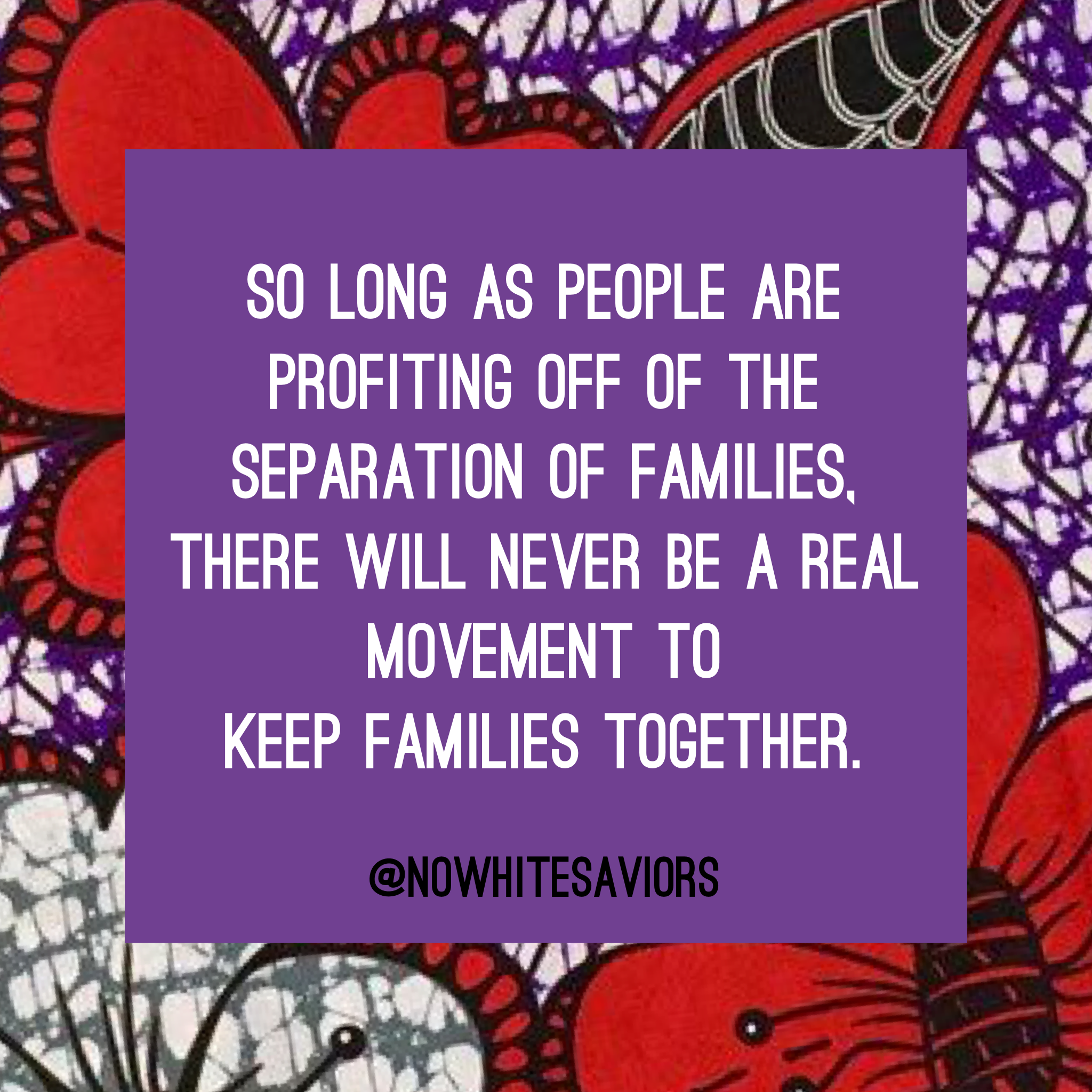
International Adoption and the White Savior Industrial Complex (https://medium.com/@nowhitesaviors/international-adoption-and-the-white-savior-industrial-complex-8075c4a67a57)
The National Council For Adoption (NCFA) is working to focus more seriously on foster and adoptive parent recruitment and retention. “We want to make is so that every child in foster care finds a loving, permanent home where they can thrive.” (NCFA) Which includes identifying barriers to successful outcomes, awareness of policy and programming in a state and local level and creating blueprints for nation foster care success. Adoption requirements and restrictions are different from each agency and each country. All together the chances of a child finding a forever home should be made easier. For example, in the United States it is extremely challenging to follow through with an international adoption if the couple is not married. Compared to Uganda, in order to adopt you must be at least 25 years old and 21 years older than the child who you’ve planned to adopt. Also, if you aren’t married you can only adopt a child of the same sex. In Uganda they are also have stronger restrictions than the United States if you have a criminal history. Such tight requirements make is nearly impossible for an individual to successfully complete an international adoption when a United States citizen.

Article 16 of Universal Declaration of Human Rights ( https://qz.com/1309132/all-the-things-you-can-do-to-help-end-family-separations-at-the-us-mexico-border/?fbclid=IwAR1fIP7mT8KIKchEOYuuA107i2sP076UgTgz6qP-4cxyBUfLHmDn8_6svNo)
The Universal Declaration of Human Rights was an organized layout, “It sets out, for the first time, fundamental human rights to be universally protected.” (UN General Assembly, 1948) Certain articles of this documentation reflect on families and the rights of living they are entitled to. Specifically, Article 16 states, “Men and women of full age, without any limitation due to race, nationality or religion, have the right to marry and to found a family.” The same article also states, “The family is the natural and fundamental group unit of society and is entitled to protection by society and the state.” Both statements in the certain article defend that if qualified, all individuals should have the opportunity to pursue adoption if that is their choice on how to form a family. Article 25 also has to do with human rights when it comes to family terms. “Motherhood and childhood are entitled to special care and assistance. All children, whether born in or out of wedlock, shall enjoy the same social protection.” All circles back around to how the children should have an appropriate living environment no matter where the biological parents are at in life.

President Clinton signing the Adoption and Safe Family Act Law (https://www.c-span.org/video/?95351-1/adoption-safe-families-bill-signing)
On November 19, 1997, President Bill Clinton signed the law for the Adoption and Safe Family Act. This act was put into place to focus more on the children’s safety and health versus reuniting the child(ren) with birth parents. This is when the needs of the children came first, instead of the needs of the birth parents. The provisions to the law include rules, exceptions and clarification about the support services offered. “Under the new rules, states must hold hearings on a child’s future within 12 months of being removed from the family, instead of 18 months as previously stipulated. Officials no longer must make ‘reasonable efforts’ to return children to parents if they have been abandoned, tortured or chronically abused.” (Baker, Peter. The Washington Post) The improved guidelines that are being followed are to decrease the time that it takes to find permanent placement for any child(ren) in the system.

Human Population Planning (https://www.wikiwand.com/en/Human_population_planning)
Population planning is a practice put in place to intentionally control the growth rate of the human population. Before the 1950’s population planning was used with an end goal to increase the rate of human population. Which eventually raised concern for the effects it was causing to the environment such as poverty, political stability and environmental degradation. Which lead to countries enforcing a “one-child policy” to better control the population rate. Population planning can be used in two ways, to increase the human population or decrease it. It is not likely that population planning will ever be used again to try an increase the human population. Although acts like this one are put into place to control the environment, they are going against individuals human rights on founding a family.

Parents Sacked During China's One-Child Policy Petition.. (https://www.scmp.com/news/china/policies-politics/article/1916507/parents-sacked-during-chinas-one-child-policy-petition)
A strategy that was used in China to control the size of their population violates the right to fund a happy family. While other countries allow the family, specifically the women to choose how many children she would like, in China they enforce a limit. By far the most extreme way to handle population planning. There was a prior law in place that allowed for two child births until modified to the current one, allowing a mother to experience one child birth. To enforce the birth limits the government required us of sterlizations, contraception and abortions to ensure families could not expand. Contradicting to the right for fund a family, government in China awarded the families that successfully followed the one-child policy.

Process of changes effecting the Obama Administration (obama administration adoption)
When referring back to Article 25 of the Universal Declaration of Human Rights it states, “Everyone has the right to a standard of living adequate for the health and well-being of himself and of his family, including food, clothing, housing and medical care and necessary social services, and the right to…” (United Nations) This human right is being violated in another recent situation dealing with immigrant families trying to cross the border. Children who are caught underage as prior from the Deferred action for Child Arrival created through the Obama Administration will get detained right at the border. They are then brought to holding cell that are already overpopulated, lack food and no place to sleep. Not only is this causing abandonment of the child to the family limiting them to all the basic human resources that their allow the right to. When a child is left years of abandonment there is no way to access the family, health care or necessary social services.

Orphanage abuse at an old Burlington Orphanage that went under investigation in 2018, speaking with alive victims (https://www.burlingtonfreepress.com/story/news/2018/09/07/burlington-orphanage-abuse-police-investigate-survivors-stories/1225843002/)
An orphanage make the process and transition of adoption more challenging. The process of adoption should be a happy situation with the end goal being the importance to fund a healthy family for a child and orphan experiences make that nearly impossible. A couple from Terre Haute, Indiana adopted a total of three boys from a Chinese Centennial-based agency (CCAI) and soon learned how abused and mistreated children were while residing there. Not only did the agency lie about each one of the boys ages, but they also kept a secret very critical information about the third boy the Indiana family adopted, who was sexually harassing younger boys in the orphanage. The sexual harassment continued to take place in the household that all three boys got adopted into and it wasn’t until months later that the adoptive parents figured out what was going on. Orphanages take advantage of children who are too young to know better or speak for themselves, as a basic human right all children should be properly cared for and in a healthy living environment.
Raise adoption awareness (accept adoption.com)
Using adoption to fund a family should be just as normalized as child birth. Since some women aren’t able to have children or just want to give a loving home to the millions that don’t already have one. The outcome of adoption is always what’s best for the children’s sake, not birth parents and not adoptive parents. There are many situations and reasons prior to the adoption step that make the road more challenging which shouldn’t be the case. All barriers that are going against the Universal Declaration of Humans Rights needs to be fixed if we ever want a chance for everyone, specifically children to be able to have a happy, healthy life.
Baker, Peter. “CLINTON SIGNS LAW TO SPEED ADOPTION PROCESS FOR CHILDREN IN FOSTER CARE.” The Washington Post, WP Company, 20 Nov. 1997, www.washingtonpost.com/archive/politics/1997/11/20/clinton-signs-law-to-speed-adoption-process-for-children-in-foster-care/7524ca07-a863-4649-9ebb-a5019bd28512/.
“Couple Sues Adoption Agency after 1 Adopted Child Rapes 2 Others.” fox5sandiego.Com, 19 Aug. 2019, fox5sandiego.com/2019/08/19/couple-sues-adoption-agency-claiming-they-werent-told-boy-had-sexual-abuse-history/
Smith, Donna. “When Is a Human Right a Human Right?” Health Care for All Colorado, 3 May 2013, www.healthcareforallcolorado.org/human_right.
Zinda. “Adoption Statistics in the U.S.” Visual.ly, 11 July 2015, visual.ly/community/infographic/other/adoption-statistics-us
Universal Declaration of Human Rights. United Nations, 2017.
Baker, Peter. “CLINTON SIGNS LAW TO SPEED ADOPTION PROCESS FOR CHILDREN IN FOSTER CARE.” The Washington Post, WP Company, 20 Nov. 1997, www.washingtonpost.com/archive/politics/1997/11/20/clinton-signs-law-to-speed-adoption-process-for-children-in-foster-care/7524ca07-a863-4649-9ebb-a5019bd28512/
Wu, J. “Population and Family Planning in China.” Verhandelingen - Koninklijke Academie Voor Geneeskunde Van Belgie, U.S. National Library of Medicine, 1994, www.ncbi.nlm.nih.gov/pubmed/7892742
Campbell, Patricia J., et al. An Introduction to Global Studies. Wiley-Blackwell, 2014.
Peter Joseph, The New Human Rights. Texas: BenBella Books, 2017
Kwame Anthony Appiah. Cosmopolitanism: Ethics In A World Of Strangers. New York: WW Norton and Company, 2006

No comments:
Post a Comment