Thursday, December 5, 2019
HRR CONVIVIUM! Meet in Fireside Lounge on Wednesday, December 11 from 2:30 to 3:30. Bring your PROF POSTER!
Design and deploy a professional poster on your HRR research project!
Follow these handy video tips to create a fantastic professional poster.
And here's Cecelia's A worthy poster:
Suggestions: Aim for at least FIVE images and FIVE text blocks, arranged to "flow" in some professionally strategic manner to visually share the story of your HRR topic with your audience!
Wednesday, December 4, 2019
Tuesday, December 3, 2019
Courtnee Cox
Rob Williams
December 1, 2019
Kids in Cages
In May of 2019, 63.6 percent of the immigrants coming into the United States were families. Of this 63.6 percent, 8.6 percent of them were children who were crossing the border alone (Ting, 2019). Many of the underage immigrants coming to the U.S. stem from the Deferred Action for Child Arrival (DACA). This program was created by the Obama administration to help immigrant children who come to the U.S for safety. DACA gives them the resources they need to live. These children who are detained at the border are being brought to holding cells that are extremely overpopulated, and are given little to no food and are not provided adequate space to sleep. Many children are getting sick from the amount of overpopulation and are not given the right to a doctor. The Universal Declaration of Human Rights Article 25 states, “Everyone has the right to a standard of living adequate for the health and well-being of himself and of his family, including food, clothing, housing and medical care and necessary social services” (United Nations, 1948). Border control is breaking this human rights law by putting many children in great danger of health and even death. THE UNITED STATES NEEDS TO CREATE A PLAN FOR CHILDREN FROM OTHER COUNTRIES WHO ARE SEEKING HELP SO THEY CAN FEEL SAFE AND HAVE BASIC HUMAN RESOURCES.
Many families are traveling to the United States illegally in search of help from the mistreatment in their own country. Many are being caught; as a result, their families are being ripped apart never seeing each other again. “The Trump Administration has separated over 2,300 children from their families at the U.S.-Mexico border since 2017” (Hildreth, 2019). The Trump Administration created a policy to tear families who are caught apart, it is called the “zero-tolerance” policy. This policy orders that 100% of the parents that are caught crossing the border with their children be separated. Both the parents and the children are detained in holding cells apart from each other. Not only are the children separated from their parents, but most likely they are separated from their other siblings as well. The Trump Administration created this policy in hopes that it would be so cruel that it would stop immigrants from wanting to enter the U.S illegally.
The Trump administration’s theory failed and the courts denied the policy and demanded that the children be returned to their families. The administration failed to abide by this request, resulting in many more separations. The exact amount of separations is unknown due to the lack of tracking separations. Trump made a statement on ABC News stating, "Nobody talks about that, but under President Obama, they separated children from the parents" (Flaherty, 2018). The difference between DACA and Trump's Zero Tolerance act is that DACA wasn't looking to separate families and the few who were separated was due to major drug trafficking.
Once children are taken from their families and are detained, they are turned in to the Department of Homeland Security (DHS). The law states that children must be put in the care of the Department of Health and Human Services (HHS) within 72 hours of being detained at the border. HHS has 11,200 beds for children who are under government custody, this is not nearly enough beds for the number of children coming HHS’s care. Since there is a lack of space for these children coming in, the Trump Administrations opened up “tent cities” along the Texas border. Each tent can hold up to 20 children and 2 adults, the city as a total can hold up to 4,000 children (Hildreth, 2019). Many children who are being detained are put in very dangerous situations and the government is failing to follow the law. Many children are being held in a cage cells, with little to no food or water, no space to lie down and sleep, or even adequate temperatures to not get sick.
The government is not taking into consideration how this physically and mentally affects children. According to Dr. Alan Shapiro with the American Academy of Pediatrics,
As children develop, we know their brains change in response to the environments they’re in. Detention leads to very serious distress which is called toxic stress. Toxic stress can impair brain development and cause lasting damage. The report really spells out in black and white the consequences that the zero-tolerance policy has for children. To keep a child in one of those centers is cruel and unusual punishment. As cited in America's voice, 2019
Not only are children’s basic living needs not being met, resulting in illness that is not being treated, but also it is so traumatic for the child to be stuck in such poor living conditions that it alters their brains.
The Department of Health and Human Services provides education for the children in their care until they get permanent placements where they can go to public school. According to the Office of Refugee Resettlement (2019), “Each unaccompanied alien child must receive a minimum of six hours of structured education, Monday through Friday, throughout the entire year in basic academic areas (Science, Social Studies, Math, Reading, Writing, Physical Education, and English as a Second Language (ESL), if applicable)”. In addition to taking classes after school hours, children have access to a tutor for additional help with school work. Although these children in custody may not be getting the best education, they are most likely getting more education than what they had in their home country. The requirements state that there must be a diverse cultural reflection on the context they are learning in the classrooms so the children feel safer. The children are not permitted to take more than a two-week break from school. “Unaccompanied alien children may be separated into class groups according to their academic development, level of literacy, and linguistic ability rather than by chronological age” (Office of Refugee Resettlement,2019). Children are separated to best benefit the child academically, but this also means they are being separated from the people they are comfortable with such as other siblings. Unaccompanied children are also provided with special opportunities such as independent study, special projects, pre-GED classes and college preparatory tutorials.
Although our government has improved on the quality of care for illegal immigrants, they still break many human rights laws, most concerningly human rights law in regards to children. Children are not permitted to be detained in a jail cell for more than 72 hours, but some reported they had been held for three to four weeks in a jail cell. “The Border Patrol claims that high numbers of border arrivals are causing these delays as they wait for space to open up in the somewhat more child-friendly detention centers and shelters run by the Office of Refugee Resettlement at US Health and Human Services” (Long, 2019). Officers are holding children longer rather than finding a more permanent placement for the child. This is why there is overcrowding in the jail cells and people are getting sick. Most children who are being held are unable to talk to their parents and the parents are completely unaware that they are even in government custody. These children being held don't have access to showering and clean clothing. When children are able to shower they don't generally have access to soap. “The US government argued in court on Tuesday that its obligation to provide “safe and sanitary” conditions does not require it to provide kids with hygiene items such as soap or toothbrushes” (Long, 2019). Many children in custody are not old enough to feed and bath themselves, but the government is unwilling to help with this so other kids who are older and are strangers have to help out. Our government needs to find a better system for helping the children coming to our country seeking help.
The United States has in the past tried creating a system to keep under aged children who are crossing the border safe; this program is known as deferred action for childhood arrivals (DACA). “On June 15, 2012, the Secretary of Homeland Security announced that certain people who came to the United States as children and meet several guidelines may request consideration of deferred action for a period of two years, subject to renewal”(U.S. Citizenship and Immigration Services, 2017). Although this plan is to keep children safe and give them rights in America, it doesn't make them legal citizens. Although this plan is to keep children who are seeking help safe, there are many flaws in the program many might not be aware of. There is a long list of requirements a child must meet in order to be eligible for DACA. In many cases it is impossible to meet DACA’s requirements and often children do not get in the program, such as being over the age of 16, not having proper documentation stating you have been in the U.S. for a certain period of time, and not having the money to pay for the application presses which is almost $500.00 (U.S. Citizenship and Immigration Services, 2017). These standards are unreasonable. The United States makes this process difficult so that the children don't want to come to the U.S., but many of them have no other choice and as a result have to suffer the consequences.
There are many ways we can help the children who are being mistreated and having their human rights be taken away from them. One way we can help these children is volunteering with an organization who works with the children to advocate for them such as the United Nations Children’s Fund (UNICEF). “UNICEF is using its decades of humanitarian expertise to promote the protection of migrant children and their rights in their home countries or wherever their journeys take them”(UNICEF, 2019). Another way we can help is by donating to organizations such as UNICEF to help they get the supplies the children need to live. The other major thing we could do to improve the safety and living state of these children is to only elect officials who support the rights of immigrant children . President Donald Trump thinks with an old fashioned thought about how no immigrant should be allowed in to the U.S. no matter what the circumstance is. This has made the living conditions for these unaccompanied children extremely worse than it has been in the past. Trump has cut funding for living supplies for these children, and he has set policies in place make being stuck at the border so horrible that no one would want to come to the U.S. Although this did the opposite effect Trump wanted it to have because more people came to the border because they felt it was their only chance before things got even worse. If we elect a different president in the upcoming election, we can get Trump out of the White House and elect someone who values human rights and children’s rights.
The Trump administration has created a new act in hopes of keeping illegal aliens from trying to cross the U.S border called the Zero-tolerance Act. This plan did not work; if anything, it has made illegal crossings increase. From 2018 to 2019 the amount of border crossings have doubled. When former president Obama was in office the amount of illegal crossings were at an all time low, once Trump became president the numbers began to rapidly increase. “While figures show that illegal border crossings have seen an overall decline since 2000, they have been rising again since Mr Trump took office” (Bailey, Rodgers 2019). Children are being ripped from their families and their human rights are being violated. They do not have access to food, water, adequate sleeping space, and even doctors. Many of these children never see their family again and have to suffer the poor conditions that border control puts them through. This Act violates the human rights of children which is stated in the Universal Declaration of Human Rights, Article 25. How can our country create a long lasting plan to protect the human rights of immigrant minors, while also working on illegal border crossing?
Work Cited
Bailey, D, & Rodgers, D (2019). Trump wall - all you need to know about US border in seven charts. BBC News. Retrieved from https://www.bbc.com/news/world-us-canada-46824649
Hildreth, M. (2019). Immigration 101: what is zero tolerance family separation? America’s Voice. Retrieved from https://americasvoice.org/blog/separation-of-children/?gclid=EAIaIQobChMI3vSY_Lmc5QIVQz0MCh0gEAi0EAAYAiAAEgLOtvD_BwE
Office of Refugee Resettlement. (2019). Children entering the united states unaccompanied. Retrieved from https://www.acf.hhs.gov/orr/resource/children-entering-the-united-states-unaccompanied-section-3#3.3.5
Ting, J. (2019). Kids in cages, the inhumane treatment at the border. Center For Immigration Studies. Retrieved from https://cis.org/Testimony/Kids-Cages-Inhumane-Treatment-Border?gclid=EAIaIQobChMIhvDhr86F5QIVUdbACh1-hQ87EAAYASAAEgJtXPD_BwE
United Nations. (1949). Universal declaration of human rights. Retrieved from https://www.un.org/en/universal-declaration-human-rights/
Long, C. (2019). Children at risk in u.s border jails. Human Rights Watch. Retrieved from https://www.hrw.org/news/2019/06/20/children-risk-us-border-jails#
UNICEF. (2019). Our mission. Retrieved from https://www.unicefusa.org/mission
Flaherty, A. (2018). Retrieved from https://abcnews.go.com/Politics/trump-falsely-blames-obama-family-separations-border/story?id=58908866
U.S Citizenship and Imaragtion Services. (2017). https://www.uscis.gov/archive/consideration-deferred-action-childhood-arrivals-daca
Monday, December 2, 2019
Copyright laws and the game industry- Ryan Coring
https://docs.google.com/document/d/1j91z5SvAkm-7NGnoFgvvFkApT0hSwnRXGYxAhzXucLQ/edit?usp=sharing
The Right to Privacy
Our human rights regarding the Right to Privacy.
One of the main topics in protecting our privacy is technology. As technology evolves, more of our personal information is in the hands of third parties. From smartphones to emails and social media. The right to privacy is protected by statutory law. For example, the Health Information Protection Portability and Accountability Act (HIPAA) which protects a person's health information. Any person should have the right to determine what type of information about them is collected and how/where that information would be used. U.S SUPREME COURT ESTABLISHED THE RIGHT TO PRIVACY IN 1972. “NOBODY HAS THE RIGHT TO COME INTO OUR HOME, OPEN OUR LETTERS, OR BOTHER US OR OUR FAMILY WITHOUT A GOOD REASON.”(UDHR)
Where’s our privacy? We are being monitored.
GPS monitors your movements, and your smart TV or webcam can watch you. Practically all the data these gadgets gather can be offered to organizations or utilized by governments and law authorization to keep tabs or gather evidence. Although at the same time, we use technology so often as a society just because with it, things get done faster with less effort. “The ACLU Works to expand the right to privacy, increase the control individuals have over their personal information and ensure civil liberties are enhanced rather than compromised by technological innovation.”(ACLU) The federal law protecting electronic information was passed in 1986, making it older than the World Wide Web.
Protection for our medical records
Most of us believers that our health and medical information are private and ought to be secured. It's the people's right to know who has all this information. The rights under HIPAA which is The Privacy Rule, a Federal law that gives rights over our medical and health information and sets limits to who can have access to our health information. It applies to everyone, it’s there to protect health information, regardless of whether electronic, written or oral. Examples of what's protected, Information doctors, nurses, and other health care providers put in one’s medical record, Billing information for a clinic, Conversations a doctor has about personal care or treatment with nurses and others regarding the patient. (HHS.org) As for one to make sure all health information is protected, questions must be asked such as, ask to see a copy of health records, have corrections to health information, receive a notice that tells how one's health information may be used and shared.
Enforcing privacy rights.
The federal government protects personal information through a series of laws intact by Congress. The Federal Trade Commission (FTC) is the primary agency enforcing privacy policy and enforcement since the 1970s. There is the Fair Credit Reporting Act: One of the first federal privacy laws. It uses the protection of the law to provide data. The Privacy Act of 1974: Prevents the federal government from making unauthorized disclosure of personal information under its control. Computer Fraud and Abuse Act: A federal anti-hacking statute that prohibits the unauthorized use of protected computers without prior authorization, including smartphones or other devices connected to the internet. Children's Online Privacy Protection Act: COPPA imposes requirements on online services directed at children under 13, as well as those that knowingly collect information from children under the age of 13. These entities must post their privacy policies, have an opt-out option, and provide certain parental controls. Financial Monetization Act: Requires financial institutions to explain their information-sharing practices to their customers and to safeguard sensitive customer information.
Amendments created to protect the people.
The article, FindLaw Team, mentions the amendments that involve the right to privacy. First Amendment: Provides the freedom to choose any kind of religious belief and to keep that choice private. Third Amendment: Protects the zone of privacy of the home. Fourth Amendment: Protects the right of privacy against unreasonable searches and seizures by the government. Fifth Amendment: Provides for the right against self-incrimination, which justifies the protection of private information.
Changes in privacy over time.
The rights of privacy have changed a lot over time, we have less of it. First off, a few years ago, technology was something new to our society and it wasn't as advanced and fast. People have less privacy today because of advanced technology. The word flies a lot faster today, we have all these social media outputs, medical information, etc that can reveal important information about an individual. “to obtain welfare, mortgages, or credit cards, we disclose our names, addresses, social security numbers, employment history, and financial worth. To gain relief, we tell clergy, physicians, and lawyers some of the most intimate details of our lives and we allow or expect surveillance to maintain social order (e.g., we expect cameras in the lobby of a bank to deter robbers” (Evolution of privacy)
Protests to make a change regarding abortion.
January 22, 1973, Roe V. Wade was a landmark decision of the U.S Supreme Court. Addressing the protection of a pregnant women’s liberty which allows her to choose to have an abortion without having to go through excessive government restrictions. Roe stood up for this right because it “violated a woman’s constitutional right of privacy, which is found to be implicit in the liberty guarantee of the due process clause of the Fourteenth Amendment”( Britannica) Through this, the right to privacy was developed.
President Richard Nixon's reelection campaign.
Technological advances and changes in legislative arrangements changed the idea of privacy issues and along these lines the laws during the 1970s and 80s. The Watergate occurrence which is a scandal started promptly of the day of June 17, 1972, when a few burglars were captured in the workplace of the Democratic National Committee, situated in the Watergate complex of structures in Washington, D.C. This was no standard burglary, The prowlers were associated with President Richard Nixon's reelection campaign, and they had been discovered wiretapping telephones and stealing documents played a significant role in informing the degree and content of these laws. In addition to a federal privacy act, Congress passed enactment that illuminated privacy rules overseeing specific areas and established fair information practices.
Privacy Acts.
The Fair Credit Reporting Act of 1970 requires credit-revealing administrations to receive sensible techniques to guarantee the precision of individual data contained in their credit reports, yet doesn't limit the sum or kind of data gathered. The Federal Privacy Act of 1974 attempts to forbid government agencies from uncovering any data they keep about an individual by utilizing the individual's name or some other personally recognizing number or image. The Electronic Communications Privacy Act of 1986 bans listening stealthily on the verbally expressed individual communications yet doesn't make a general right to security in phone or email correspondences.
Our rights will determine our safety, security, and happiness.
Privacy laws are established because we have a right to privacy, to an extent. For many years people have argued over their privacy rights, from online videos to citizens spying on them, even stealing internet. Americans think that they should be completely secluded from others seeing what they’re doing, but in all reality, there’s no stopping others from seeing what’s being done. With more using the flaws within our media and lives, we as a society must come to accept the fact that we’re being watched, wether from our phones, social media or home accessories such as Alexa or Google Home. At this time and age, protecting our privacy isn’t that easy. “They who can give up essential liberty to obtain a little temporary safety, deserve neither liberty nor safety.”(Benjamin Franklin)
Citations
Appiah, Anthony. Cosmopolitanism: Ethics in a World of Strangers. , 2006. Print.
“Universal Declaration of Human Rights.” United Nations, United Nations, https://www.un.org/en/universal-declaration-human-rights/.
Linder, Douglas O. The Right of Privacy: Is It Protected by the Constitution?, http://law2.umkc.edu/faculty/projects/ftrials/conlaw/rightofprivacy.html.
History.com Editors. “Watergate Scandal.” History.com, A&E Television Networks, 29 Oct. 2009, https://www.history.com/topics/1970s/watergate.
Olr. The Evolution of Privacy: A Look at the Past, Present,and Future, https://www.cga.ct.gov/PS98/rpt\olr\htm/98-R-1455.htm.
“Right to Privacy: Constitutional Rights & Privacy Laws.” LiveScience, Purch, https://www.livescience.com/37398-right-to-privacy.html.
“Students: Your Right to Privacy.” American Civil Liberties Union, https://www.aclu.org/other/students-your-right-privacy.
HeinOnline, https://heinonline.org/HOL/LandingPage?handle=hein.journals/hlr4&div=31&id=&page=.
Brandeis, Louis, and Samuel Warren. "The right to privacy." Harvard law review 4.5 (1890): 193-220.
Thomson, Judith Jarvis. "The right to privacy." Philosophy & Public Affairs (1975): 295-314.
O'Brien, Denis. "The Right of Privacy." Columbia Law Review 2.7 (1902): 437-448
https://www.axios.com/watergate-donald-trump-presidency-scandal-a9c29d6e-b91a-4918-a749-7d0f9550955b.html
President Richard Nixon's reelection campaign.
Technological advances and changes in legislative arrangements changed the idea of privacy issues and along these lines the laws during the 1970s and 80s. The Watergate occurrence which is a scandal started promptly of the day of June 17, 1972, when a few burglars were captured in the workplace of the Democratic National Committee, situated in the Watergate complex of structures in Washington, D.C. This was no standard burglary, The prowlers were associated with President Richard Nixon's reelection campaign, and they had been discovered wiretapping telephones and stealing documents played a significant role in informing the degree and content of these laws. In addition to a federal privacy act, Congress passed enactment that illuminated privacy rules overseeing specific areas and established fair information practices.
https://govbooktalk.gpo.gov/2013/06/28/the-privacy-act-what-the-government-can-collect-and-disclose-about-you/
Privacy Acts.
The Fair Credit Reporting Act of 1970 requires credit-revealing administrations to receive sensible techniques to guarantee the precision of individual data contained in their credit reports, yet doesn't limit the sum or kind of data gathered. The Federal Privacy Act of 1974 attempts to forbid government agencies from uncovering any data they keep about an individual by utilizing the individual's name or some other personally recognizing number or image. The Electronic Communications Privacy Act of 1986 bans listening stealthily on the verbally expressed individual communications yet doesn't make a general right to security in phone or email correspondences.
http://thejaffes.org/content/right-privacy
Our rights will determine our safety, security, and happiness.
Privacy laws are established because we have a right to privacy, to an extent. For many years people have argued over their privacy rights, from online videos to citizens spying on them, even stealing internet. Americans think that they should be completely secluded from others seeing what they’re doing, but in all reality, there’s no stopping others from seeing what’s being done. With more using the flaws within our media and lives, we as a society must come to accept the fact that we’re being watched, wether from our phones, social media or home accessories such as Alexa or Google Home. At this time and age, protecting our privacy isn’t that easy. “They who can give up essential liberty to obtain a little temporary safety, deserve neither liberty nor safety.”(Benjamin Franklin)
Citations
Appiah, Anthony. Cosmopolitanism: Ethics in a World of Strangers. , 2006. Print.
“Universal Declaration of Human Rights.” United Nations, United Nations, https://www.un.org/en/universal-declaration-human-rights/.
Linder, Douglas O. The Right of Privacy: Is It Protected by the Constitution?, http://law2.umkc.edu/faculty/projects/ftrials/conlaw/rightofprivacy.html.
“{{Meta.pageTitle}}.” {{Meta.siteName}}, https://www.oyez.org/cases/1971/70-18.
History.com Editors. “Watergate Scandal.” History.com, A&E Television Networks, 29 Oct. 2009, https://www.history.com/topics/1970s/watergate.
Olr. The Evolution of Privacy: A Look at the Past, Present,and Future, https://www.cga.ct.gov/PS98/rpt\olr\htm/98-R-1455.htm.
“Right to Privacy: Constitutional Rights & Privacy Laws.” LiveScience, Purch, https://www.livescience.com/37398-right-to-privacy.
Sunday, December 1, 2019
Adoption Video: https://youtu.be/C6Le3gO1mqc
When Is A Human Right A Human Right (https://www.healthcareforallcolorado.org/human_right)
Adoption is one of the many methods to success found a family. Article 25 in the Universal Declaration of Human Rights states that "Everyone has the right to a standard of living adequate for the health and well-being of himself and of his family, including food, clothing, housing and medical care and necessary social services, and the right to security in the event of unemployment, sickness, disability, widowhood, old age or other lack of livelihood in circumstances beyond his control." In many circumstances there are restrictions on allowing this type of life event to occur in a household. The process of adoption is intended to take place as a permanent change in the guardianship of an individual. Provisions are set in place to do what is best for the child and not the birth parents. By 2050, this planet is estimated to home more than nine billion people. Adoption is a right for a couple to grow their family, for themselves, the planet and the children who ache for a family.
Adoption Statistics in the United States of America (https://visual.ly/community/infographic/other/adoption-statistics-us)
Children all over the world who are in search of a family. In just the United States there are over 400,000 children in foster care, 114,556 of those children cannot be returned to their biological parents. More than 60% of these children spend 2-5 years in fostering before they are adopted. (Adoption Network Law Center) Foster care is intended to be a temporary living situation for children whose biological parents or unfit, unable or unwilling to take care of them. Children are entered through foster care at no fault of their own, they have been abused, neglected, abandoned or are unable to continue living safely with their families. The end goal is usually to reunite the children with the birth parents, if it is deemed a safe decision for the children. The needs of the children should be taken into consideration more importantly, not the needs or wants of the parents.

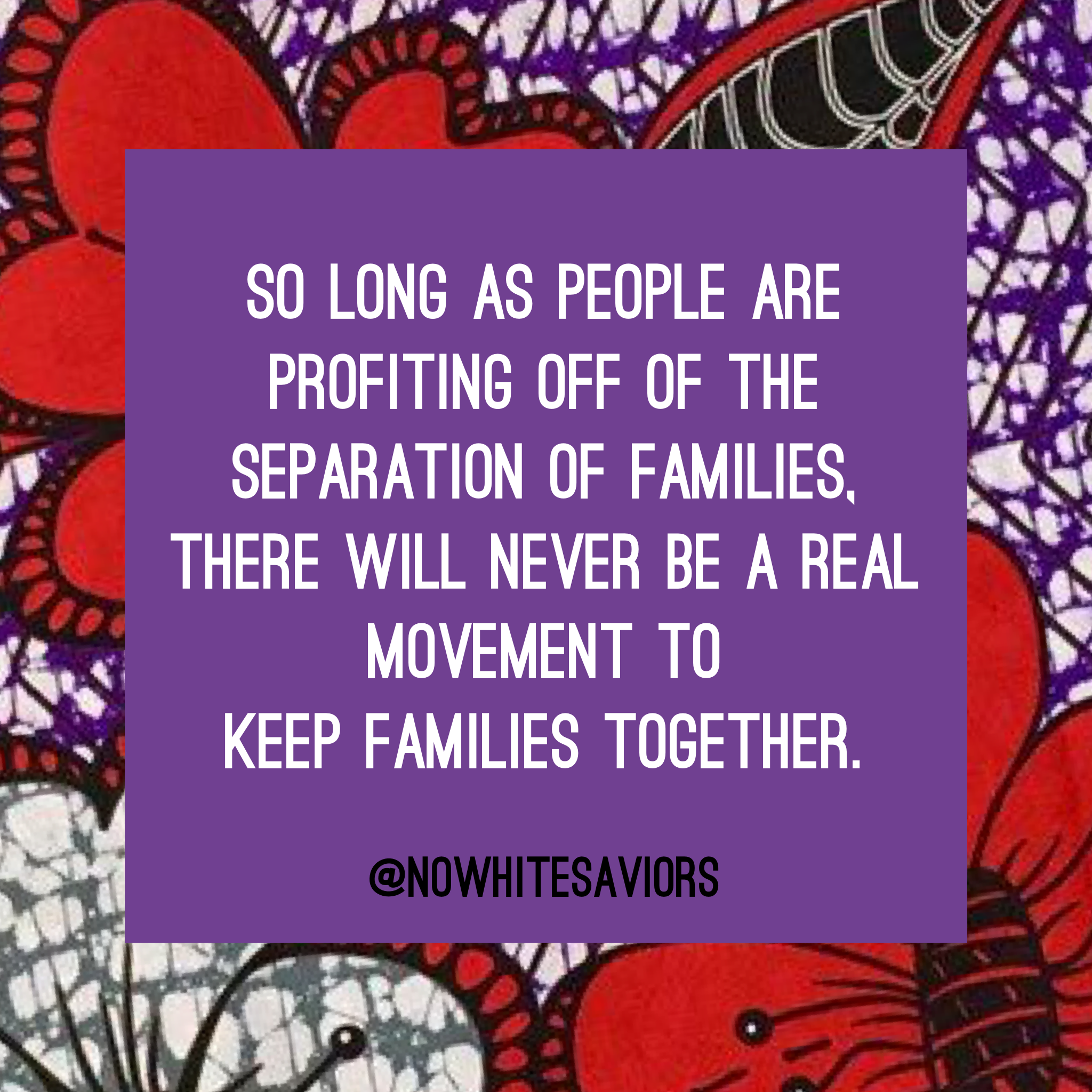
International Adoption and the White Savior Industrial Complex (https://medium.com/@nowhitesaviors/international-adoption-and-the-white-savior-industrial-complex-8075c4a67a57)
The National Council For Adoption (NCFA) is working to focus more seriously on foster and adoptive parent recruitment and retention. “We want to make is so that every child in foster care finds a loving, permanent home where they can thrive.” (NCFA) Which includes identifying barriers to successful outcomes, awareness of policy and programming in a state and local level and creating blueprints for nation foster care success. Adoption requirements and restrictions are different from each agency and each country. All together the chances of a child finding a forever home should be made easier. For example, in the United States it is extremely challenging to follow through with an international adoption if the couple is not married. Compared to Uganda, in order to adopt you must be at least 25 years old and 21 years older than the child who you’ve planned to adopt. Also, if you aren’t married you can only adopt a child of the same sex. In Uganda they are also have stronger restrictions than the United States if you have a criminal history. Such tight requirements make is nearly impossible for an individual to successfully complete an international adoption when a United States citizen.
Article 16 of Universal Declaration of Human Rights ( https://qz.com/1309132/all-the-things-you-can-do-to-help-end-family-separations-at-the-us-mexico-border/?fbclid=IwAR1fIP7mT8KIKchEOYuuA107i2sP076UgTgz6qP-4cxyBUfLHmDn8_6svNo)
The Universal Declaration of Human Rights was an organized layout, “It sets out, for the first time, fundamental human rights to be universally protected.” (UN General Assembly, 1948) Certain articles of this documentation reflect on families and the rights of living they are entitled to. Specifically, Article 16 states, “Men and women of full age, without any limitation due to race, nationality or religion, have the right to marry and to found a family.” The same article also states, “The family is the natural and fundamental group unit of society and is entitled to protection by society and the state.” Both statements in the certain article defend that if qualified, all individuals should have the opportunity to pursue adoption if that is their choice on how to form a family. Article 25 also has to do with human rights when it comes to family terms. “Motherhood and childhood are entitled to special care and assistance. All children, whether born in or out of wedlock, shall enjoy the same social protection.” All circles back around to how the children should have an appropriate living environment no matter where the biological parents are at in life.
President Clinton signing the Adoption and Safe Family Act Law (https://www.c-span.org/video/?95351-1/adoption-safe-families-bill-signing)
On November 19, 1997, President Bill Clinton signed the law for the Adoption and Safe Family Act. This act was put into place to focus more on the children’s safety and health versus reuniting the child(ren) with birth parents. This is when the needs of the children came first, instead of the needs of the birth parents. The provisions to the law include rules, exceptions and clarification about the support services offered. “Under the new rules, states must hold hearings on a child’s future within 12 months of being removed from the family, instead of 18 months as previously stipulated. Officials no longer must make ‘reasonable efforts’ to return children to parents if they have been abandoned, tortured or chronically abused.” (Baker, Peter. The Washington Post) The improved guidelines that are being followed are to decrease the time that it takes to find permanent placement for any child(ren) in the system.

Human Population Planning (https://www.wikiwand.com/en/Human_population_planning)
Population planning is a practice put in place to intentionally control the growth rate of the human population. Before the 1950’s population planning was used with an end goal to increase the rate of human population. Which eventually raised concern for the effects it was causing to the environment such as poverty, political stability and environmental degradation. Which lead to countries enforcing a “one-child policy” to better control the population rate. Population planning can be used in two ways, to increase the human population or decrease it. It is not likely that population planning will ever be used again to try an increase the human population. Although acts like this one are put into place to control the environment, they are going against individuals human rights on founding a family.
Parents Sacked During China's One-Child Policy Petition.. (https://www.scmp.com/news/china/policies-politics/article/1916507/parents-sacked-during-chinas-one-child-policy-petition)
A strategy that was used in China to control the size of their population violates the right to fund a happy family. While other countries allow the family, specifically the women to choose how many children she would like, in China they enforce a limit. By far the most extreme way to handle population planning. There was a prior law in place that allowed for two child births until modified to the current one, allowing a mother to experience one child birth. To enforce the birth limits the government required us of sterlizations, contraception and abortions to ensure families could not expand. Contradicting to the right for fund a family, government in China awarded the families that successfully followed the one-child policy.

Process of changes effecting the Obama Administration (obama administration adoption)
When referring back to Article 25 of the Universal Declaration of Human Rights it states, “Everyone has the right to a standard of living adequate for the health and well-being of himself and of his family, including food, clothing, housing and medical care and necessary social services, and the right to…” (United Nations) This human right is being violated in another recent situation dealing with immigrant families trying to cross the border. Children who are caught underage as prior from the Deferred action for Child Arrival created through the Obama Administration will get detained right at the border. They are then brought to holding cell that are already overpopulated, lack food and no place to sleep. Not only is this causing abandonment of the child to the family limiting them to all the basic human resources that their allow the right to. When a child is left years of abandonment there is no way to access the family, health care or necessary social services.

Orphanage abuse at an old Burlington Orphanage that went under investigation in 2018, speaking with alive victims (https://www.burlingtonfreepress.com/story/news/2018/09/07/burlington-orphanage-abuse-police-investigate-survivors-stories/1225843002/)
An orphanage make the process and transition of adoption more challenging. The process of adoption should be a happy situation with the end goal being the importance to fund a healthy family for a child and orphan experiences make that nearly impossible. A couple from Terre Haute, Indiana adopted a total of three boys from a Chinese Centennial-based agency (CCAI) and soon learned how abused and mistreated children were while residing there. Not only did the agency lie about each one of the boys ages, but they also kept a secret very critical information about the third boy the Indiana family adopted, who was sexually harassing younger boys in the orphanage. The sexual harassment continued to take place in the household that all three boys got adopted into and it wasn’t until months later that the adoptive parents figured out what was going on. Orphanages take advantage of children who are too young to know better or speak for themselves, as a basic human right all children should be properly cared for and in a healthy living environment.

Raise adoption awareness (accept adoption.com)
Using adoption to fund a family should be just as normalized as child birth. Since some women aren’t able to have children or just want to give a loving home to the millions that don’t already have one. The outcome of adoption is always what’s best for the children’s sake, not birth parents and not adoptive parents. There are many situations and reasons prior to the adoption step that make the road more challenging which shouldn’t be the case. All barriers that are going against the Universal Declaration of Humans Rights needs to be fixed if we ever want a chance for everyone, specifically children to be able to have a happy, healthy life.
Baker, Peter. “CLINTON SIGNS LAW TO SPEED ADOPTION PROCESS FOR CHILDREN IN FOSTER CARE.” The Washington Post, WP Company, 20 Nov. 1997, www.washingtonpost.com/archive/politics/1997/11/20/clinton-signs-law-to-speed-adoption-process-for-children-in-foster-care/7524ca07-a863-4649-9ebb-a5019bd28512/.
“Couple Sues Adoption Agency after 1 Adopted Child Rapes 2 Others.” fox5sandiego.Com, 19 Aug. 2019, fox5sandiego.com/2019/08/19/couple-sues-adoption-agency-claiming-they-werent-told-boy-had-sexual-abuse-history/
Smith, Donna. “When Is a Human Right a Human Right?” Health Care for All Colorado, 3 May 2013, www.healthcareforallcolorado.org/human_right.
Zinda. “Adoption Statistics in the U.S.” Visual.ly, 11 July 2015, visual.ly/community/infographic/other/adoption-statistics-us
Universal Declaration of Human Rights. United Nations, 2017.
Baker, Peter. “CLINTON SIGNS LAW TO SPEED ADOPTION PROCESS FOR CHILDREN IN FOSTER CARE.” The Washington Post, WP Company, 20 Nov. 1997, www.washingtonpost.com/archive/politics/1997/11/20/clinton-signs-law-to-speed-adoption-process-for-children-in-foster-care/7524ca07-a863-4649-9ebb-a5019bd28512/
Wu, J. “Population and Family Planning in China.” Verhandelingen - Koninklijke Academie Voor Geneeskunde Van Belgie, U.S. National Library of Medicine, 1994, www.ncbi.nlm.nih.gov/pubmed/7892742
Campbell, Patricia J., et al. An Introduction to Global Studies. Wiley-Blackwell, 2014.
Peter Joseph, The New Human Rights. Texas: BenBella Books, 2017
Kwame Anthony Appiah. Cosmopolitanism: Ethics In A World Of Strangers. New York: WW Norton and Company, 2006
Subscribe to:
Posts (Atom)